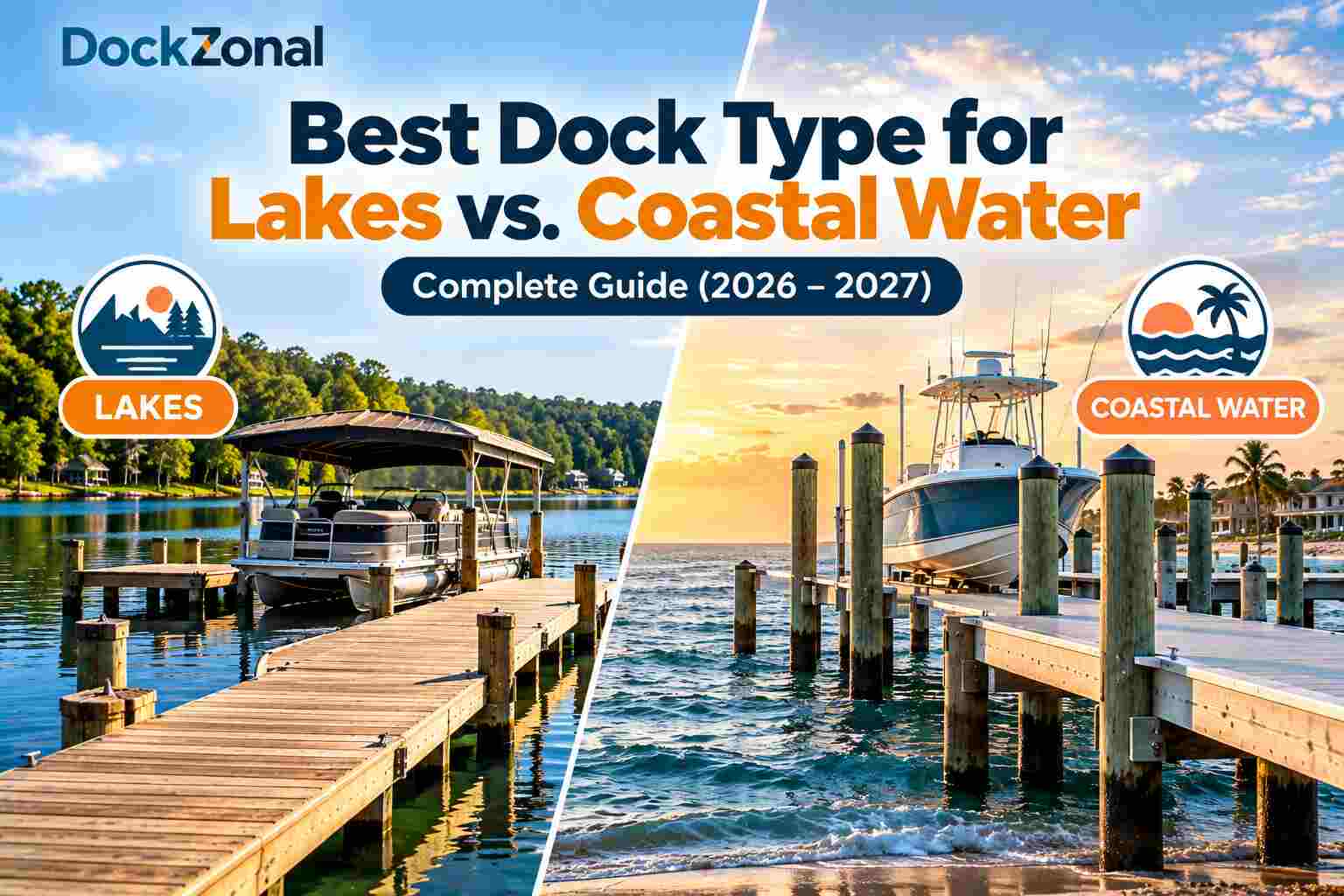
Best Dock Type for Lakes vs. Coastal Water
The best dock for a calm freshwater lake may be very different from the best dock for a tidal bay, canal, river or exposed coastal property. Water-level changes, tides, waves, currents, storms, ice, water depth and bottom conditions all influence which dock system makes sense.
Floating docks, fixed piling docks, pipe docks, lift docks and combination systems can all be good choices in the right environment. The key is matching the dock to the actual conditions at the property rather than choosing a design based only on appearance or price.
Updated for 2026–2027 planning.
There is no universal “lake dock” or “coastal dock.” Two properties on the same waterbody can require different designs because shoreline exposure, depth and site conditions can change dramatically.
Not Sure Which Dock Type Fits Your Waterfront?
Tell us where your property is located, what type of water you’re on and what you want from your dock. DockZonal can help connect your request with dock professionals serving your area to discuss dock types, pricing and availability.
Request Quote & Availability✓ Free to submit ✓ No obligation
What Type of Dock Is Best for a Lake?
Lakes vary enormously. Some have relatively stable water levels and calm protected shorelines. Others experience large seasonal drawdowns, heavy recreational boat wakes, winter ice or deep water close to shore.
Because of this, several dock types can work well on lakes.
Floating Dock
Often useful where lake levels rise and fall because the dock moves vertically with the water. It can also provide a consistent boarding height for boats.
Fixed Dock
Can work very well where water levels are reasonably stable and the bottom is suitable for a piling- or post-supported structure.
Pipe or Post Dock
Common on some shallower inland waters where posts or legs can support the structure and site conditions allow this type of installation.
Seasonal or Removable Dock
Can be useful on northern lakes where ice makes year-round installation undesirable or where local owners routinely remove docks before winter.
Lift Dock
Some lake systems can be raised above the water during storms, winter conditions or periods when the dock is not being used.
Combination Dock
A fixed walkway connected to a floating section can provide benefits of both systems when water depth or changing levels vary across the site.
When a Floating Dock Makes Sense on a Lake
A floating dock can be particularly useful when water levels fluctuate. Because the structure floats, it rises and falls with the lake.
This can make boat access easier during periods of changing water level.
Floating docks may also work well where driving numerous permanent pilings is undesirable or where a modular dock system fits the property’s needs.
However, a floating dock still requires an anchoring or guide system. Significant waves, wakes, wind and winter ice can influence how that system must be designed.
When a Fixed Dock Makes Sense on a Lake
Fixed docks can be an excellent choice where lake levels remain reasonably predictable.
They generally provide a rigid, permanent-feeling platform because the dock is supported by pilings, posts or another fixed foundation rather than flotation.
A fixed dock may be particularly attractive when:
- Water levels are relatively stable
- The bottom is suitable for the support system
- You want a solid deck-like feel
- You want a permanent waterfront structure
- The design includes a piling-supported boat lift
What Type of Dock Is Best for Coastal Water?
Coastal docks face a different set of conditions. Tides, saltwater, currents, storm surge, waves, wind, marine organisms and corrosion can all influence dock design.
Fixed piling docks are widely used in coastal environments, but they are not the only option.
Floating docks are common in marinas and at some residential properties, particularly where tidal changes make a floating boarding surface useful.
Combination systems are also common, with a fixed pier leading to a gangway and floating dock.
Fixed Piling Docks in Coastal Water
Fixed docks can provide a strong, permanent structure when pilings are appropriately designed and installed for the site.
Coastal piling design may need to account for:
- Tidal range
- Water depth
- Bottom conditions
- Wave forces
- Current
- Storm conditions
- Debris impact
- Marine organisms
- Boat loads
Floating Docks in Coastal Water
Floating docks can offer an important advantage in tidal areas: the dock rises and falls with the water.
That can keep the dock surface at a relatively consistent height in relation to the boat.
The challenge is controlling the dock’s movement. The anchoring or piling guide system needs to accommodate the expected tidal range while also handling waves, wakes, currents and wind.
Fixed Pier With a Floating Dock
A combination design can be particularly useful on tidal waterfronts.
A fixed pier extends from shore and provides stable access. A gangway then slopes down to a floating dock that moves with the tide.
This can provide a stable walkway from shore while maintaining convenient boat access across changing water levels.
Floating Docks: Where Do They Work Best?
Floating docks deserve consideration anywhere significant water-level variation makes a fixed deck height inconvenient.
They may work well on:
- Lakes with seasonal water-level changes
- Reservoirs with controlled drawdowns
- Tidal bays
- Protected coastal waterways
- Canals
- Marinas
- Some rivers
But “floating” does not mean suitable everywhere.
Highly exposed locations, strong currents, major waves, severe ice or insufficient water depth can create additional design challenges.
For a deeper comparison, see Floating Dock vs. Fixed Dock.
Fixed Piling Docks: Where Do They Work Best?
Fixed piling docks are used in both freshwater and saltwater environments.
They can work particularly well when:
- A permanent structure is desired
- The bottom supports piling installation
- Water levels are predictable enough for the chosen deck elevation
- A solid platform is important
- A piling-supported boat lift is planned
- Local waterfront construction practices favor piling-supported docks
The main limitation is that the deck itself does not move with the water. Significant changes in water level can therefore change the height between the dock and the boat.
What About Pipe Docks and Post Docks?
Pipe docks and post-supported docks are common on some freshwater lakes, especially where the water is relatively shallow and bottom conditions allow the supports to be installed.
Some systems are lightweight enough to be installed and removed seasonally.
They can be attractive where:
- Water is relatively shallow
- The bottom is suitable
- Wave exposure is moderate
- Seasonal removal is desirable
- Heavy permanent marine construction is unnecessary
These systems may be less suitable where deep water, strong waves, large tidal changes or heavy-duty structural requirements are present.
What Is a Lift Dock?
A lift dock is designed so the dock structure can be raised above the water rather than remaining at one fixed operating height.
These systems can be useful in certain lake environments where owners want to raise the dock during storms, winter conditions or extended periods of non-use.
Suitability depends on the shoreline, water depth, bottom conditions, system design and local practices.
When Is a Combination Dock Best?
You do not always have to choose between an entirely fixed or entirely floating system.
Combination docks can solve waterfront conditions that change between shore and deeper water.
A common configuration includes:
- A fixed pier or walkway from shore
- A gangway
- A floating terminal platform or boat slip
This can be useful when the owner wants stable access from shore but also needs the boating portion of the dock to move with changing water levels.
Building a Lake or Coastal Dock?
A local dock professional can evaluate your water depth, shoreline, bottom conditions, waves, tides and boating needs before recommending a dock system.
Get Dock Quotes & Availability✓ Free to submit ✓ No obligation
Water Levels: One of the Most Important Factors
Water-level behavior should be one of the first things evaluated before choosing a dock.
Stable Water Levels
Where water levels remain relatively consistent, a fixed dock can maintain a practical relationship to the water throughout much of the year.
Seasonal Lake Fluctuation
Some lakes and reservoirs experience substantial seasonal changes. A fixed dock may become unusually high during low water or too close to the water during high-water periods.
A floating system can adjust vertically with those changes, assuming enough water remains underneath it.
Tides
Tidal waterfronts repeatedly change water elevation.
Fixed docks remain at the same height while boats move up and down with the tide. Floating docks move with the boats.
The amount of tidal change at the specific property should therefore be considered during dock design.
How Waves, Boat Wakes and Currents Affect Dock Choice
A calm protected cove and an exposed open-water shoreline are very different construction environments even when they are on the same lake or bay.
The dock design may need to account for:
- Normal wind-driven waves
- Large boat wakes
- Current direction and speed
- Open-water exposure
- Passing commercial traffic
- Seasonal storms
Floating docks move with water forces, so flotation and anchoring need to be designed appropriately.
Fixed docks resist those forces through their structural framing and foundation.
What Dock Type Is Best for Storm-Prone Coastal Areas?
There is no dock design that eliminates storm risk.
Coastal storms can expose docks to:
- Storm surge
- High waves
- Strong winds
- Fast currents
- Floating debris
- Boat impacts
- Rapid changes in water level
A fixed dock may face substantial forces when water rises to or above the deck structure.
A floating dock can rise with water, but its guide pilings, anchors, connections and gangway must remain suitable throughout the expected range of movement.
In storm-prone areas, local design requirements and experience with that particular coastline or waterbody become especially important.
What Dock Type Is Best Where Lakes Freeze?
Ice can exert significant forces on docks, pilings, floats and shoreline structures.
In northern lake regions, many property owners use docks designed for seasonal removal or systems that can be lifted or moved before winter.
Whether a dock can remain in the water depends on:
- Dock type
- Waterbody
- Ice thickness
- Ice movement
- Water-level changes
- Anchoring system
- Manufacturer recommendations
- Local experience
A dock that successfully remains installed year-round on one northern lake may not be appropriate on another with more aggressive ice movement.
How Water Depth Affects Dock Type
Water depth affects both design and construction cost.
Shallow Water
Shallow sites may work with posts, pipes, pilings or other fixed supports depending on bottom conditions.
Floating docks require sufficient water beneath the flotation to avoid repeatedly grounding as levels change.
Deep Water
Deep water can increase the cost and complexity of piling-supported docks because longer pilings and specialized equipment may be necessary.
Floating systems may reduce some piling requirements, but they still need a properly designed anchoring or guide system.
Bottom Conditions Matter Too
What is underneath the water can be just as important as what happens above it.
Bottom conditions may include:
- Sand
- Mud
- Clay
- Rock
- Soft sediment
- Mixed materials
These conditions influence piling installation, anchoring and foundation design.
A contractor familiar with the local waterbody may already have experience with typical bottom conditions in the area.
Best Dock Materials for Lakes vs. Coastal Water
Dock type and decking material are separate decisions.
Both lake and coastal docks may use:
- Pressure-treated wood
- Composite decking
- Aluminum
- Engineered floating systems
- Concrete floats in some applications
Lake Dock Materials
On freshwater lakes, owners may prioritize initial cost, appearance, barefoot comfort, seasonal removal and maintenance.
Coastal Dock Materials
Saltwater adds corrosion concerns. Fasteners, brackets, structural components, electrical equipment and boat-lift components should be appropriate for the environment.
Material selection should consider the complete dock system rather than decking alone.
If you’re comparing deck surfaces, see Wood vs. Composite Docking.
Lake vs. Coastal Boat Lift Considerations
If you plan to install a boat lift, include it in the dock design from the beginning.
The lift can affect:
- Piling placement
- Slip width
- Dock configuration
- Structural requirements
- Electrical service
- Water-depth requirements
Coastal installations may also need to account for tidal range, saltwater exposure and stronger environmental forces.
Lake installations may need to account for seasonal water-level changes, drawdowns and winter conditions.
For budgeting, see the Boat Lift Cost Guide.
Which Dock Type Is Best for Fishing?
Fishing alone does not usually determine whether a dock should be fixed or floating.
Instead, consider features that make the dock more useful for fishing:
- Enough platform space
- Access to suitable water depth
- Lighting where permitted
- Rod holders
- Fish-cleaning area
- Water service
- Storage
- Safe walking surfaces
A wide platform may matter more to an angler than whether the structure floats.
Which Dock Type Is Best for Swimming?
Swimming access depends on water depth, bottom conditions, boat traffic and local safety considerations.
Useful features may include:
- Swim ladder
- Low boarding height
- Dedicated swim area
- Non-slip decking
- Separation from boat-lift equipment
Floating docks can provide convenient low access to the water, but fixed docks can also be designed with ladders, stairs or lower platforms.
Which Dock Type Is Best for Kayaks and Paddleboards?
Low access to the water is particularly useful for kayaks, canoes and paddleboards.
Floating docks naturally maintain a consistent relationship to the water, which can make launching easier.
A fixed dock can accomplish something similar with a lower platform or dedicated paddlecraft launch.
Does a Lake Dock Cost Less Than a Coastal Dock?
Not necessarily, although coastal construction can involve conditions that increase complexity.
Dock cost depends on:
- Size
- Dock type
- Materials
- Water depth
- Bottom conditions
- Access
- Piling requirements
- Engineering
- Permits
- Boat lifts
- Electrical work
- Local labor and equipment costs
A simple lake dock can be relatively affordable, while a large deep-water lake project can be expensive.
Likewise, a protected coastal dock may be less complicated than a large structure on an exposed shoreline.
See the Dock Building Cost Guide for broader project pricing information.
Compare Dock Options for Your Property
Your waterbody, shoreline and boating needs should drive the design. Tell us about your project and DockZonal can help connect your request with dock professionals serving your area.
Request Dock Quote & Availability✓ Free to submit ✓ No obligation
How to Choose the Best Dock Type for Your Property
Before choosing a dock, answer these questions about the property.
1. Is It Freshwater or Saltwater?
Saltwater exposure increases corrosion concerns and can affect material, hardware and equipment selection.
2. How Much Does the Water Level Change?
Large seasonal or tidal changes can make a floating or combination system particularly useful.
3. How Deep Is the Water?
Depth affects piling length, floating-dock clearance, equipment needs and construction cost.
4. What Is the Bottom Like?
Sand, mud, rock and other bottom conditions can affect both pilings and anchoring.
5. How Exposed Is the Property?
A protected canal or cove may experience very different forces than an open lake, bay or coastal shoreline.
6. Does the Water Freeze?
Ice can influence whether the dock should remain installed year-round or be removable, liftable or otherwise designed for winter conditions.
7. What Boat Will Use the Dock?
Boat size, weight, draft and desired lift can affect dock dimensions, water-depth requirements and structural design.
8. How Will You Use the Dock?
Boating, fishing, swimming, entertaining, kayaking and other uses may call for different platform sizes, elevations and accessories.
Questions to Ask a Dock Builder
- Which dock type works best on this specific waterbody?
- Why do you recommend that system for my property?
- How much does the water level change here?
- How does the dock handle high and low water?
- What wave and wake conditions should we design for?
- Is current an issue at this property?
- What are the bottom conditions?
- How deep is the water?
- What piling or anchoring system is required?
- What happens during major storms?
- Does the dock need seasonal removal?
- How does ice affect the design?
- Which materials do you recommend?
- Can the dock accommodate my boat?
- Can it accommodate a boat lift?
- What permits and approvals are required?
- Who handles permitting?
- What maintenance should I expect?
- What is the estimated installed cost?
- When could construction begin?
Don’t Choose a Dock Type Based Only on Your Neighbor’s Dock
Looking at nearby docks can be useful because they show which systems are common on the waterbody.
But your neighbor’s dock is not automatically the correct design for your property.
Even adjacent lots can differ in:
- Water depth
- Bottom conditions
- Shoreline shape
- Exposure
- Existing structures
- Boat requirements
- Permitted footprint
Use nearby docks as useful reference points, not as substitutes for a site-specific evaluation.
Frequently Asked Questions
What is the best dock for a lake?
Floating, fixed, pipe, lift and removable docks can all work well on lakes. The best option depends on water-level changes, depth, bottom conditions, waves, winter ice and how the dock will be used.
What is the best dock for saltwater?
Fixed piling docks, floating docks and combination systems are all used in saltwater environments. Tidal range, waves, current, storm exposure, corrosion and local requirements should guide the choice.
Are floating docks good for lakes?
They can be, especially where lake levels change significantly. Floating docks rise and fall with the water, but anchoring, waves, wakes and winter conditions still need to be considered.
Are floating docks good for coastal water?
Floating docks are commonly used in many protected coastal and tidal environments. Their anchoring or guide systems must be designed for the expected tide, waves, wakes, currents and wind.
What type of dock is best for changing water levels?
Floating docks often deserve strong consideration because they rise and fall with the water. Combination systems using a fixed pier, gangway and floating section can also work well.
What type of dock is best for a lake that freezes?
Seasonal, removable, liftable and other locally proven dock systems may be appropriate. The best choice depends on ice thickness, ice movement, depth, water-level changes and local conditions.
Are fixed docks better for rough water?
Not automatically. Both fixed and floating docks can be designed for demanding conditions, but the appropriate system depends on the actual wave, wake, current, depth and storm exposure at the site.
Can I use a fixed dock with a floating section?
Yes. A fixed pier connected by a gangway to a floating dock is a common combination where stable shore access and changing water levels both need to be accommodated.
Which dock type works best with a boat lift?
The answer depends on the lift type, boat size, water depth, dock configuration and site conditions. If a lift is planned, it should be considered during the initial dock design rather than added as an afterthought.
Find Dock Builders for Your Lake or Coastal Property
Whether you’re planning a lake dock, tidal dock, fixed pier, floating system or complete waterfront project, tell us what you’re building and where your property is located.
Find Dock Professionals✓ Free to submit ✓ No obligation
Planning Guide Disclaimer: This guide provides general educational information. Dock suitability, design, permitting, materials and construction requirements vary by property, waterbody and jurisdiction. Site-specific conditions should be evaluated by appropriately qualified local professionals before construction.


Leave a Reply