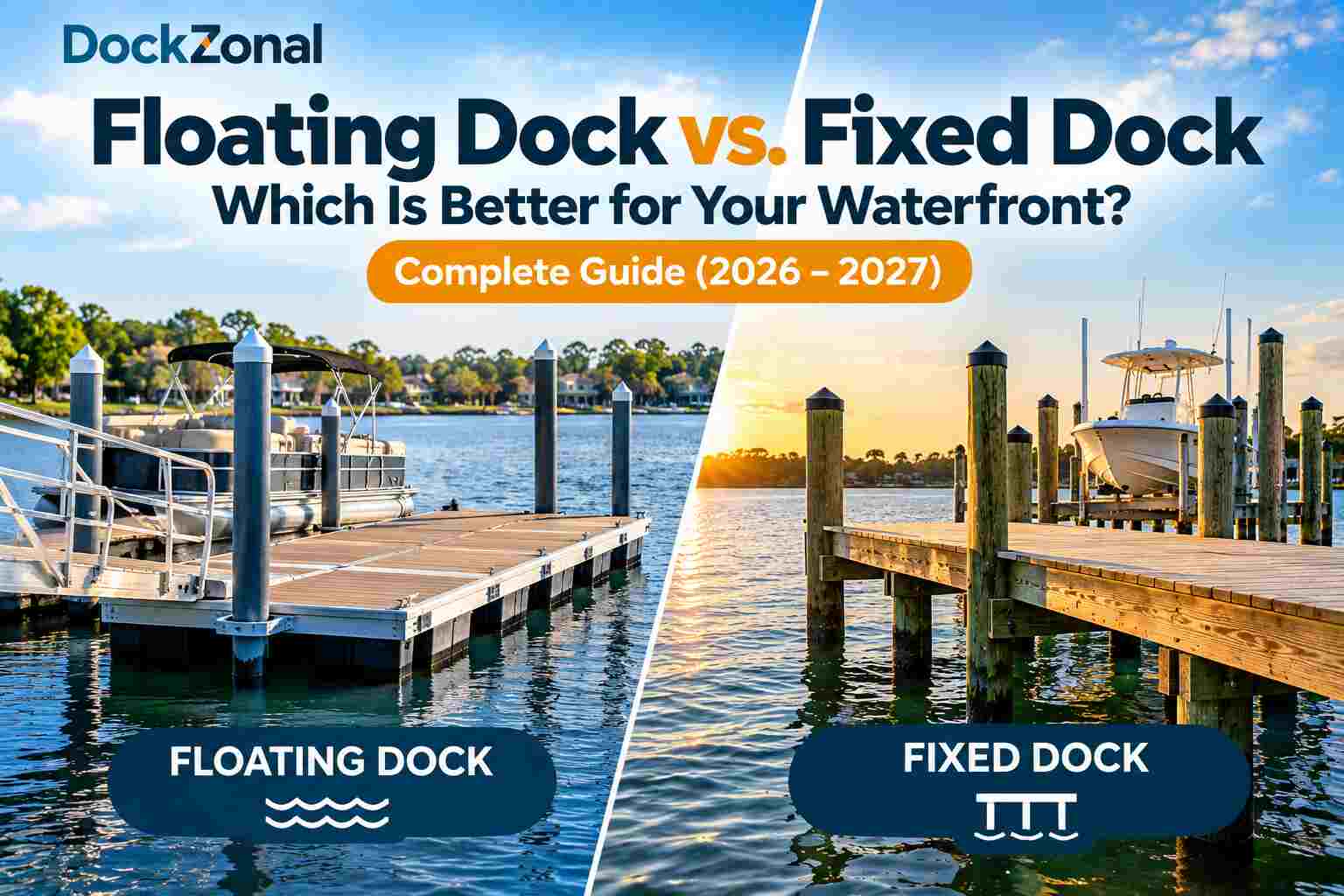
Floating Dock vs. Fixed Dock: Which Is Better for Your Waterfront?
The biggest difference between a floating dock and a fixed dock is how the structure responds to changing water levels. A floating dock rises and falls with the water, while a fixed dock is supported above the water by pilings or posts.
Neither design is automatically better. The right choice depends on water depth, water-level changes, waves, currents, bottom conditions, boat size, local regulations, winter conditions and how you plan to use the dock.
Updated for 2026–2027 planning.
Site conditions matter more than a general rule. A design that works extremely well on one lake, river or coastal property may be a poor choice a few miles away.
Not Sure Which Dock Type Fits Your Property?
Tell us about your waterfront, boat and project. DockZonal can help connect your request with dock professionals serving your area to discuss floating and fixed dock options, pricing and availability.
Request Quote & Availability✓ Free to submit ✓ No obligation
What Is a Floating Dock?
A floating dock is supported by flotation rather than being held at one fixed elevation above the water.
The dock rises and falls as the water level changes. It is typically connected to shore by a gangway and held in position using pilings, guide systems, cables, anchors or another engineered anchoring method.
Floating docks can be constructed from wood, aluminum, composite materials, polyethylene modules, concrete floats or combinations of materials.
Common Floating Dock Components
- Floating dock frame or modules
- Flotation units
- Decking
- Gangway
- Anchoring system
- Piling guides or brackets, where used
- Cleats and boat hardware
What Is a Fixed Dock?
A fixed dock—also commonly called a stationary dock—is supported by pilings, posts or another foundation and remains at a set elevation rather than floating with the water.
Pilings are commonly driven into the bottom and support the framing and decking above the water.
Fixed docks are common along lakes, rivers, canals, bays and coastal properties where site conditions allow a permanent piling-supported structure.
Common Fixed Dock Components
- Pilings or posts
- Structural beams
- Joists
- Decking
- Hardware and connectors
- Railings, where used
- Boat lifts or other accessories
The Biggest Differences Between Floating and Fixed Docks
Water-Level Response
Floating docks move vertically with the water. Fixed docks remain at approximately the same elevation regardless of ordinary water-level changes.
Feel Underfoot
A fixed dock generally feels more like a permanent deck. A floating dock naturally moves to some degree with waves, wakes and people walking on it.
Foundation
Fixed docks typically rely on pilings or posts. Floating docks rely on flotation plus an anchoring or guide system.
Boarding Height
A floating dock maintains a more consistent height relative to the water, which can simplify boarding when water levels fluctuate.
Site Suitability
Bottom conditions, water depth, waves, currents, ice and water-level changes can make one system more appropriate than the other.
Configuration
Floating systems can offer modular flexibility, while fixed docks can provide a highly solid platform for permanent waterfront use.
Which Is Better for Changing Water Levels?
This is one of the strongest reasons to consider a floating dock.
Because the dock rises and falls with the water, the distance between the dock surface and water remains relatively consistent.
A fixed dock stays at one elevation. If water drops substantially, the dock may sit unusually high above the boat. If water rises significantly, the water can approach or potentially overtop the deck depending on the event and design.
Which Dock Feels More Stable?
A properly constructed fixed dock generally feels more rigid because its structure is supported by pilings rather than flotation.
Floating docks naturally move with the water. The amount of movement depends on dock size, flotation, anchoring, waves, wakes and overall design.
This does not mean a floating dock should feel excessively unstable. A properly designed system should account for the conditions where it will be installed.
Which Dock Is Better for Shallow Water?
There is no universal answer because shallow waterfronts vary considerably.
A fixed dock may work well where suitable pilings or posts can be installed. Floating docks need enough water to remain afloat without repeatedly contacting the bottom as water levels change.
Very shallow water, seasonal drawdowns or a gently sloping bottom may influence how far the dock must extend to reach usable depth.
Which Dock Is Better for Deep Water?
Deep water can make piling installation more expensive because fixed docks may require longer pilings and more specialized equipment.
A floating system may be attractive in some deep-water locations, but it still requires a suitable anchoring or guide system.
Depth alone should not determine the design. Waves, current, bottom conditions and regulatory requirements also matter.
Floating Dock vs. Fixed Dock Cost
Either dock type can range from a relatively modest residential project to a large five- or six-figure waterfront installation.
The dock type itself is only one part of the cost.
Floating Dock Costs May Include
- Floating modules or frame
- Flotation
- Decking
- Gangway
- Anchoring system
- Guide pilings, where applicable
- Installation
- Electrical or utility work
Fixed Dock Costs May Include
- Pilings
- Pile driving
- Structural framing
- Decking
- Marine hardware
- Installation equipment
- Electrical or utility work
Piling requirements can represent a major portion of fixed-dock construction costs, particularly in deep water or difficult bottom conditions.
For detailed budgeting ranges, see the Dock Building Cost Guide.
Is a Floating Dock Always Cheaper?
No. A floating dock is not automatically the inexpensive alternative to a fixed dock.
Small modular floating docks can be relatively economical, but large engineered floating systems can become expensive once flotation, anchoring, gangways, premium decking, utilities and installation are included.
Similarly, a straightforward fixed dock in favorable conditions may cost considerably less than a complex deep-water piling project.
Compare complete installed proposals rather than assuming one dock type will always cost less.
Which Dock Requires More Maintenance?
Maintenance depends heavily on materials and environment rather than dock type alone.
Floating Dock Maintenance
Components that may need inspection include:
- Flotation
- Anchoring systems
- Guide hardware
- Hinges
- Gangways
- Decking
- Connections between sections
Fixed Dock Maintenance
Components that may need inspection include:
- Pilings
- Framing
- Decking
- Fasteners
- Structural connections
- Boat-lift equipment
Material selection can have a major effect on maintenance. Wood decking, for example, has different maintenance requirements than composite or aluminum systems.
Which Is Better in Storms and Rough Water?
Neither floating nor fixed docks are immune to severe weather.
A fixed dock can be exposed to substantial wave, surge and debris forces. If water rises above the deck, structural components may experience forces they do not encounter under normal conditions.
A floating dock can rise with changing water levels, but its anchoring system, gangway and connections must handle the expected movement and forces.
The correct design depends heavily on local exposure.
Floating vs. Fixed Docks in Freezing Climates
Ice is an important design consideration in northern climates.
Some floating docks are designed to be removed seasonally or repositioned before winter. Other systems remain in place depending on the waterbody, anchoring system and manufacturer or contractor recommendations.
Fixed docks may also be affected by ice movement, freezing conditions and seasonal changes in water level.
For properties where ice is common, ask local dock professionals how each dock type performs on that specific lake, river or shoreline rather than relying on general advice from a different climate.
Which Dock Is Better for Getting On and Off a Boat?
Floating docks can have an advantage when water levels fluctuate because the dock surface stays at a more consistent height relative to the boat.
With a fixed dock, the height difference between the boat and dock changes as water levels rise and fall.
However, fixed docks can still provide excellent boat access when water levels are reasonably stable and the dock elevation is designed correctly.
Which Is Better for a Boat Lift?
Traditional piling-supported boat lifts are commonly integrated with fixed docks, but boat-lift options also exist for other waterfront configurations.
The correct setup depends on:
- Boat weight
- Boat length and beam
- Water depth
- Dock configuration
- Piling placement
- Bottom conditions
- Water-level changes
- Electrical access
If a boat lift is important to your project, discuss it before choosing the dock design rather than trying to add it after construction.
See the Boat Lift Cost Guide for more information about lift pricing and installation.
Planning a New Dock?
A local dock professional can evaluate your shoreline, water depth, water-level changes and boat needs before recommending a fixed, floating or combination system.
Get Dock Quotes & Availability✓ Free to submit ✓ No obligation
Can You Combine a Fixed Dock and a Floating Dock?
Yes. Some waterfront properties use a combination system rather than choosing one design exclusively.
For example, a property might have a fixed walkway or pier leading from shore to a gangway and floating dock.
This approach can provide the rigid feel of a fixed structure near shore while allowing the boating area to rise and fall with changing water levels.
Combination systems can be especially useful where shoreline conditions and boating conditions differ across the same property.
Floating Dock Pros and Cons
Potential Advantages
- Moves with changing water levels
- Maintains a more consistent height relative to the water
- Can provide convenient boat access
- Modular configurations may be available
- Some systems can be removed or repositioned seasonally
- Can work well where substantial water-level changes occur
Potential Disadvantages
- Moves underfoot
- Requires a suitable anchoring or guide system
- Gangways and moving connections require attention
- Wave and wake exposure can affect comfort and design
- Flotation components can eventually require repair or replacement
- May not be appropriate for every exposed waterfront
Fixed Dock Pros and Cons
Potential Advantages
- Solid, rigid feel underfoot
- Permanent platform for waterfront use
- Can integrate well with piling-supported boat lifts
- Works well where water levels are relatively predictable
- Can support substantial custom dock layouts
Potential Disadvantages
- Does not move with changing water levels
- Piling installation can add substantial cost
- Deep water can increase construction complexity
- Fixed elevation can affect boat access during low or high water
- Pilings and framing require inspection and maintenance over time
How to Choose Between a Floating and Fixed Dock
Instead of starting with “Which dock is better?”, start with the conditions at your property.
Water Level Changes Significantly
A floating dock may deserve stronger consideration because it can move vertically with the water.
Water Level Is Relatively Stable
A fixed dock may provide a solid permanent platform without creating large seasonal height differences between the dock and water.
You Want a Large Boat Lift
Discuss the boat and lift requirements with the contractor early. The lift can materially affect dock type, piling placement and structural design.
The Waterfront Is Exposed to Large Waves or Wakes
Site-specific engineering and local contractor experience become particularly important. The proposed structure and anchoring system need to match actual conditions.
The Lake Freezes
Ask whether the proposed dock should remain installed year-round or be removed seasonally, and how ice movement affects the recommended design.
You Want the Dock to Feel Like a Permanent Deck
A fixed dock generally provides the more rigid experience because it does not float on the water.
You Want Consistent Boat Boarding Height
A floating dock can be advantageous because the dock and boat rise and fall together as water levels change.
Questions to Ask a Dock Builder Before Choosing
- How much does the water level change here?
- How deep is the water where the dock will be installed?
- What are the bottom conditions?
- How strong are the typical waves and wakes?
- Is there significant current?
- Does ice affect docks in this area?
- Which dock type is most common on this waterbody, and why?
- What anchoring system would a floating dock require?
- What piling system would a fixed dock require?
- Can the design accommodate my boat?
- Can it accommodate a future boat lift?
- What maintenance should I expect?
- Are there seasonal removal requirements?
- What permits or approvals are required?
- What would each option cost at this property?
What Does It Cost to Replace an Existing Dock With a Different Type?
Changing from a fixed dock to a floating dock—or the reverse—is more than a simple decking replacement.
The project may involve:
- Demolition of the existing dock
- Debris removal
- Removing or modifying pilings
- Installing new pilings or anchors
- A new gangway
- Electrical changes
- Permit modifications
- Complete construction of the new system
See the Dock Replacement Cost Guide if you’re considering replacing an existing structure.
Frequently Asked Questions
Is a floating dock better than a fixed dock?
Neither is universally better. Floating docks can be advantageous where water levels change substantially, while fixed docks provide a rigid, permanent platform and can work very well where water levels and site conditions are suitable.
Are floating docks cheaper than fixed docks?
Not necessarily. Cost depends on dock size, materials, flotation, anchoring, gangways, pilings, water depth, access and installation conditions. Either system can become expensive on a complex waterfront.
Do floating docks move a lot?
Floating docks naturally move with waves, wakes and changing water levels. The amount of movement depends on dock size, flotation, anchoring and water conditions.
How is a floating dock anchored?
Depending on the site and system, floating docks may use pilings and guide brackets, anchors, cables or other engineered methods to hold the dock in position while allowing vertical movement.
Can a floating dock stay in the water all year?
Some can, while others may need seasonal removal depending on the dock system, waterbody, ice conditions and local practices. Follow the recommendations for the specific system and site.
Can you install a boat lift with a floating dock?
Boat-lift options exist for different dock configurations, but the correct system depends on the boat, water depth, dock design and waterfront conditions. Discuss the lift during the dock-planning stage.
Which dock is better for fluctuating water levels?
Floating docks are often well suited to changing water levels because the dock rises and falls with the water, maintaining a more consistent relationship to boats and the water surface.
Which dock is better for a lake?
Both floating and fixed docks can work well on lakes. The better fit depends on water-level fluctuations, depth, bottom conditions, wakes, winter ice, shoreline configuration and local rules.
Which dock is better for saltwater?
Both designs are used in saltwater environments. Materials, corrosion resistance, tidal range, waves, currents, storm exposure and local construction requirements are particularly important when choosing a coastal dock system.
Find Dock Builders Near You
A dock professional familiar with your local waterbody can evaluate your shoreline, water depth, bottom conditions and boating needs and help you compare fixed, floating and combination dock options.
Find Dock Builders✓ Free to submit ✓ No obligation
Planning Guide Disclaimer: This guide provides general educational information. Dock suitability, design, costs, permitting and installation requirements vary by property, waterbody, location and project. A qualified local professional should evaluate site-specific conditions before construction.


Leave a Reply