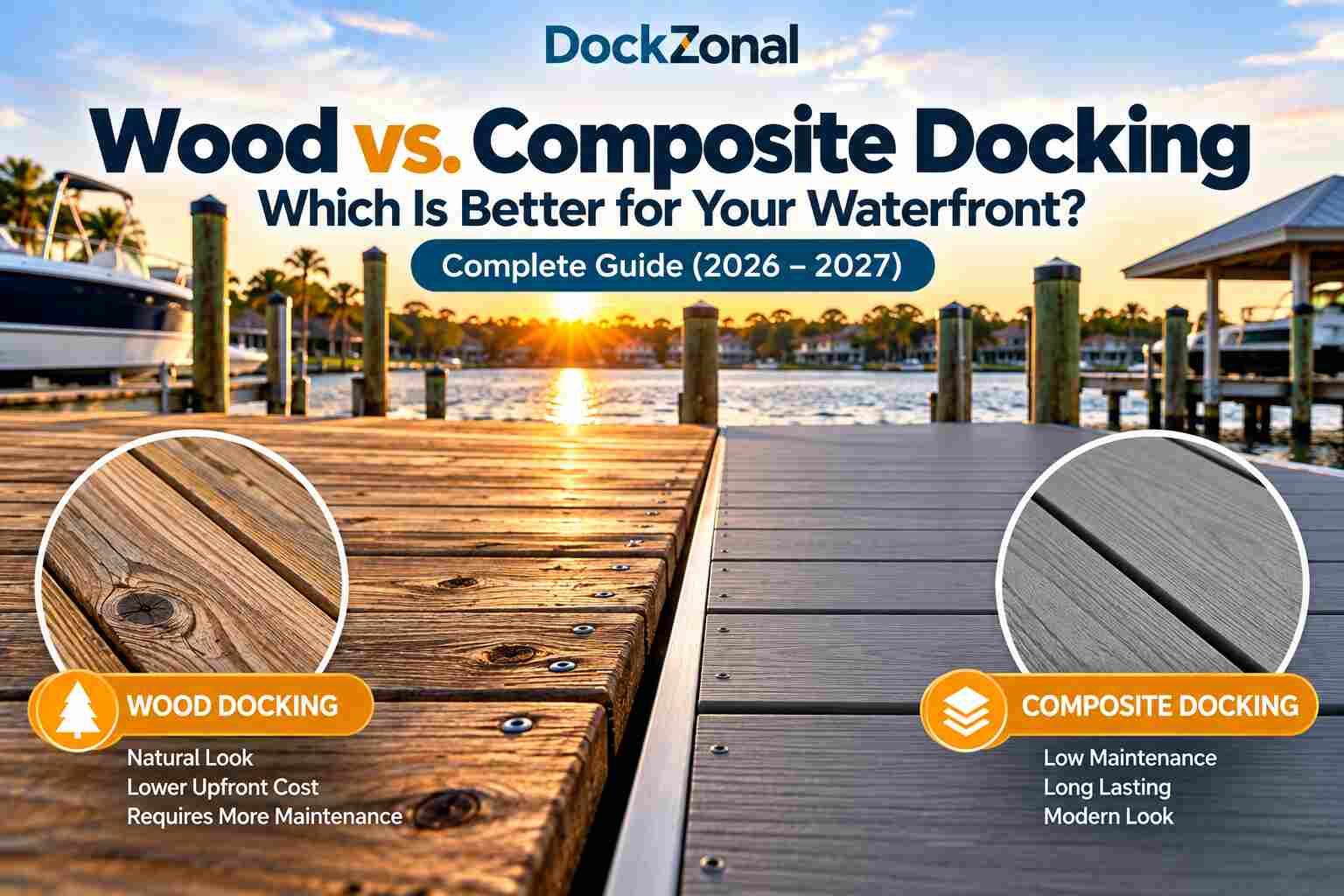
Wood vs. Composite Docking: Which Is Better for Your Dock?
Wood typically offers a lower upfront cost and the natural appearance many waterfront owners prefer. Composite decking generally costs more initially but can reduce routine maintenance and eliminates common wood-decking problems such as splintering and decay of the deck boards themselves.
The better choice depends on your budget, climate, dock design, sun exposure, maintenance expectations, desired appearance and how long you expect to own and use the dock.
Updated for 2026–2027 planning.
For many homeowners, the real decision isn’t simply which material costs less today. It is whether the higher upfront price of composite is worth the potential maintenance savings and convenience over the years you expect to own the dock.
Planning a New Dock or Dock Replacement?
Tell us about your waterfront, project and preferred materials. DockZonal can help connect your request with dock professionals serving your area so you can compare wood and composite options, pricing and contractor availability.
Request Quote & Availability✓ Free to submit ✓ No obligation
What Is Wood Dock Decking?
Wood has been used for dock decking for generations and remains common on residential waterfronts.
Pressure-treated lumber is one of the most familiar options because it is widely available and typically has a lower initial material cost than many premium composite products.
Other wood species may also be used depending on the location, desired appearance, budget and contractor recommendations.
Potential Advantages of Wood
- Generally lower upfront material cost
- Natural wood appearance
- Widely available
- Individual boards can often be replaced
- Can be stained or finished in different ways
- Familiar material for many dock builders
Potential Disadvantages of Wood
- Requires ongoing maintenance
- Can crack or splinter
- Can rot or decay over time
- May warp or cup
- Fastener areas can deteriorate
- Appearance changes as the wood weathers
- Boards may eventually require replacement
What Is Composite Dock Decking?
Composite decking is manufactured rather than cut directly from natural lumber. Products vary considerably by manufacturer and product line, but many use combinations of plastics, wood fibers, minerals or other engineered materials.
Some products include protective caps or outer layers designed to improve resistance to moisture, staining and fading.
Composite decking has become attractive for docks because waterfront decking experiences constant exposure to moisture, sun and weather.
Potential Advantages of Composite
- Does not rot in the same manner as natural wood decking
- No wood splinters
- Typically requires less routine maintenance
- Does not normally require staining
- Consistent appearance
- Available in numerous colors and textures
- Can provide long-term convenience for waterfront owners
Potential Disadvantages of Composite
- Higher upfront material cost in many cases
- Some colors can become hot in direct sunlight
- Product quality varies
- Expansion and contraction must be accounted for
- Installation requirements can differ by manufacturer
- Some products may feel less natural than real wood
- Replacing discontinued colors or profiles later can be difficult
Is Wood or Composite Docking Cheaper?
Wood generally has the advantage when comparing initial material cost. Composite products commonly cost more upfront.
But material price alone does not determine the final installed dock price.
Your total project may also include:
- Dock framing
- Pilings
- Marine hardware
- Fasteners
- Labor
- Demolition of an existing dock
- Debris removal
- Permitting
- Electrical work
- Boat lifts
- Railings and accessories
On a major dock project, upgrading the decking to composite may increase the total price without increasing it by the same percentage as the decking material alone because many of the project’s other costs remain similar.
For broader dock construction pricing, see the Dock Building Cost Guide.
Why Composite Costs More Upfront
Composite is an engineered product and is generally positioned as a lower-maintenance alternative to traditional lumber.
The premium can vary substantially depending on:
- Manufacturer
- Product line
- Board profile
- Color
- Surface texture
- Warranty
- Fastening system
- Local availability
There is also a large difference between entry-level and premium composite decking, so simply comparing “wood versus composite” can hide meaningful differences between specific products.
Wood vs. Composite Dock Maintenance
Maintenance is one of the biggest differences between the two materials.
Wood Dock Maintenance
Depending on the wood, climate and desired appearance, maintenance can include:
- Routine cleaning
- Inspecting for rot
- Checking for splinters
- Replacing damaged boards
- Replacing loose or corroded fasteners
- Staining or sealing where appropriate
- Addressing algae or organic buildup
Waterfront exposure can be demanding. Sun, moisture, freeze-thaw cycles, saltwater and constant foot traffic all affect decking.
Composite Dock Maintenance
Composite generally eliminates staining and sealing, but low maintenance does not mean no maintenance.
Composite decking can still require:
- Cleaning
- Removal of dirt and organic material
- Algae or mildew cleanup
- Inspection of fasteners
- Inspection of framing underneath
- Replacement of damaged boards when necessary
The supporting dock structure also needs maintenance regardless of what material is used on top.
Which Lasts Longer: Wood or Composite Docking?
Composite decking can offer a long service life because the boards do not decay like natural wood. However, there is no single lifespan that applies to every composite product or wood dock.
Longevity depends on:
- Material quality
- Installation quality
- Climate
- UV exposure
- Moisture
- Ventilation
- Maintenance
- Foot traffic
- Storm exposure
- Underlying dock structure
A high-quality decking surface does not compensate for deteriorating framing or failing pilings. The dock should be considered as an entire system.
Does Composite Decking Rot?
Composite decking does not rot in the same way traditional wood boards do, which is one of its major advantages in wet environments.
That does not make the entire dock rot-proof.
If composite decking is installed over wood joists, beams or other wood structural components, those components can still deteriorate.
Does Composite Decking Splinter?
Composite decking does not develop traditional wood splinters, which can be appealing on docks where people frequently walk barefoot.
Wood can become rougher as it ages and weathers, particularly if maintenance is deferred.
Individual wood species and composite products behave differently, so samples can be useful before choosing a material.
Does Composite Decking Get Hotter Than Wood?
Heat is an important consideration for waterfront decking, especially when people use the dock barefoot.
Some composite decking can become noticeably hot in direct sunlight. Color, material composition, surface texture, air temperature and sun exposure can all influence surface temperature.
Darker decking generally deserves particular consideration on docks with intense direct sun.
Wood can also become hot, but the experience can differ from composite.
Is Wood or Composite More Slippery?
Any dock surface can become slippery when wet or when algae, mildew or other organic material accumulates.
Slip resistance varies among wood surfaces and among composite products. Surface texture can make a meaningful difference.
If wet traction is a priority, ask for products intended for waterfront environments and review the manufacturer’s published specifications for the specific product being considered.
Regular cleaning remains important regardless of decking material.
Which Is Better for Saltwater?
Both wood and composite decking are used on saltwater docks.
Saltwater environments, however, place demands on more than the deck boards. Hardware, fasteners, framing, pilings, electrical components and boat-lift equipment also need to be appropriate for the environment.
Composite can be attractive because the decking itself avoids common wood-decay issues, but product selection and installation still matter.
Ask the contractor whether the specific decking product is recommended by its manufacturer for the intended waterfront application.
Which Is Better for Freshwater Docks?
Both materials can work well on freshwater docks.
The decision may come down primarily to:
- Budget
- Desired appearance
- Maintenance preferences
- Sun exposure
- Winter conditions
- Availability of materials
- How long you plan to keep the dock
For seasonal docks, also consider how the entire dock system is installed, removed or stored rather than evaluating the decking in isolation.
Which Looks Better?
Appearance is subjective.
Wood offers the grain, color variation and texture of a natural material. For many waterfront owners, that traditional appearance is a major part of its appeal.
Composite products are available in a wide range of colors, textures and wood-inspired finishes. Premium products can provide a highly consistent, finished appearance.
The larger question is how you want the dock to look not only when it is installed, but after years of sun and weather exposure.
Which Material Is Better for Bare Feet?
There are several factors to consider rather than one universal winner.
Composite avoids traditional wood splinters, while wood can feel more natural and may perform differently in direct sunlight.
For barefoot use, evaluate:
- Surface temperature
- Texture
- Slip resistance
- Splinter potential
- Fastener system
- Board condition over time
If possible, physically test samples before making a final selection.
Want to Compare Wood and Composite for Your Dock?
Tell us whether you’re building a new dock, replacing an existing dock or planning a redecking project. DockZonal can help connect your request with dock professionals serving your area.
Get Dock Quotes & Availability✓ Free to submit ✓ No obligation
Which Is Easier to Repair?
Individual boards can generally be replaced with either material, assuming compatible replacement material is available.
Wood has an advantage in availability because common lumber dimensions can often be sourced long after the original dock was constructed.
Composite can create a different challenge: manufacturers periodically change colors, textures and product lines.
If an exact product is discontinued, matching an older dock perfectly may be difficult.
Keeping several extra boards from the original installation can be useful for future repairs.
What About the Dock Framing?
Decking is only the visible surface of a dock.
Underneath it may be:
- Joists
- Beams
- Ledgers or structural connections
- Pilings
- Brackets
- Fasteners
When replacing decking, the contractor should evaluate the condition and spacing of the existing framing.
This is especially important when switching materials because the selected composite product may have specific joist-spacing and installation requirements.
Can You Replace Wood Docking With Composite?
Often, yes—provided the existing structure is suitable.
A common dock renovation involves removing aging wood boards and installing composite decking over the existing framing.
Before doing this, the contractor should evaluate:
- Joist condition
- Beam condition
- Piling condition
- Fasteners and connections
- Joist spacing
- Structural alignment
- Ventilation and drainage
- Manufacturer installation requirements
If the framing is significantly deteriorated, a larger repair or replacement project may make more sense than installing premium decking over an aging structure.
See the Dock Replacement Cost Guide if your dock needs more than new decking.
Should You Put Composite on an Old Dock?
The age of the dock alone does not determine whether composite can be installed. The condition of the supporting structure matters more.
A well-maintained older dock may still have serviceable framing. A newer dock can have significant problems if it was poorly built or heavily damaged.
Before paying for premium decking, determine whether the framing and foundation are likely to provide enough remaining service life to justify the investment.
Wood vs. Composite for a Floating Dock
Both materials can be used on floating dock systems when they are compatible with the dock design.
Weight becomes particularly important on floating structures because decking contributes to the total load the flotation system must support.
The dock designer or manufacturer should account for the selected decking when determining flotation and structural requirements.
If you are still deciding on the dock system itself, see Floating Dock vs. Fixed Dock.
Wood vs. Composite for a Fixed Dock
Fixed docks can also use either decking material.
Because the structure is supported by pilings or posts rather than flotation, the decision often centers more heavily on cost, appearance, maintenance, heat, slip resistance and compatibility with the framing.
A contractor should still confirm that framing spacing and fastening methods meet the requirements of the selected product.
Does Composite Increase the Value of a Dock?
Composite can make a dock more appealing to an owner who values lower maintenance and a finished appearance, but there is no universal dollar amount that composite decking adds to a waterfront property.
Overall dock condition, structural quality, functionality, boat access, location and the waterfront property itself can matter substantially more than decking material alone.
Choose composite primarily because its characteristics fit your ownership goals rather than assuming the entire upgrade will automatically be recovered through property value.
When Wood May Make More Sense
You Want to Keep the Initial Cost Lower
Wood can be attractive when upfront budget is the primary concern and you are comfortable taking on more maintenance over time.
You Prefer Natural Materials
If authentic wood grain and natural weathering are central to the look you want, composite may not provide the same experience.
The Dock May Be Reconfigured Soon
Investing heavily in premium decking may make less sense if you expect to substantially rebuild or change the dock in the near future.
You Don’t Mind Regular Maintenance
Homeowners comfortable cleaning, refinishing and periodically replacing boards may find wood perfectly suitable for their needs.
When Composite May Make More Sense
You Want Less Routine Maintenance
Avoiding periodic staining and sealing can be one of the strongest reasons to consider composite.
You Frequently Walk Barefoot
Eliminating traditional wood splinters can be appealing, although surface temperature and slip resistance should also be considered.
You Plan to Keep the Dock for Many Years
A higher upfront investment may be easier to justify when you expect to benefit from the material’s characteristics over a long ownership period.
You Want a Consistent Finished Appearance
Composite can provide predictable color and texture without the same natural weathering patterns found in wood.
How to Choose Between Wood and Composite
Ask yourself these questions before making the decision:
- What is my total construction budget?
- How much more will composite add to the installed quote?
- How long do I expect to own the dock?
- How much maintenance am I willing to perform?
- Will people frequently walk barefoot?
- How much direct sunlight does the dock receive?
- How important is a natural wood appearance?
- Is the dock freshwater or saltwater?
- Does the specific product have appropriate slip characteristics?
- What warranty does the manufacturer provide?
- Is the product intended for my type of dock application?
- Can replacement boards be obtained later?
Questions to Ask Your Dock Builder
- Which wood and composite products do you install most often?
- Why do you recommend those products for this waterbody?
- What is the installed price difference between wood and composite?
- Does my framing need to change for composite?
- What joist spacing does the composite manufacturer require?
- Which material stays more comfortable in direct sun?
- Which products provide good wet traction?
- How does each option perform in this local climate?
- What maintenance does the wood option require?
- What cleaning does the composite option require?
- What warranties apply?
- Does your workmanship warranty differ by material?
- Can I see completed docks using each material?
Don’t Choose Composite by Color Alone
If you’re leaning toward composite, compare actual product samples rather than selecting from website photos alone.
Evaluate:
- Surface texture
- Color in direct sunlight
- Color in shade
- Surface temperature
- Wet traction
- Board profile
- Fastening method
- Warranty terms
Different composite product lines can perform and feel very differently, even when they come from the same manufacturer.
Wood vs. Composite: Think Beyond the Deck Boards
The decking choice matters, but it should not distract from the components that determine whether the dock itself is structurally sound.
A good project also considers:
- Piling condition and design
- Framing materials
- Marine-grade hardware
- Fastener compatibility
- Water depth
- Wave and wake exposure
- Drainage and ventilation
- Boat access
- Boat-lift requirements
- Permits and local requirements
Premium decking installed over inadequate framing is not a premium dock.
Frequently Asked Questions
Is composite decking better than wood for a dock?
Composite can be a strong choice when lower routine maintenance, resistance to wood rot and avoiding splinters are priorities. Wood can make more sense when lower upfront cost and a natural appearance are more important. The better material depends on the project and owner.
Is composite dock decking worth the extra cost?
It can be for homeowners who value reduced routine maintenance and expect to keep the dock long enough to benefit from those characteristics. Ask for installed quotes for both materials so you know the actual premium for your project.
Does composite decking get hot in the sun?
It can. Surface temperature varies by product, color, composition and sun exposure. Darker materials can become particularly warm, so testing samples in direct sunlight can be useful.
Is composite decking slippery when wet?
Slip resistance varies among products. Wood and composite surfaces can both become slippery when wet or when algae and organic material accumulate. Compare the specific products being considered and keep the dock clean.
Can you put composite decking over an old dock?
Often, but the existing framing and pilings should first be evaluated. The framing must be structurally suitable and meet the installation requirements for the selected composite product.
Does composite dock decking need maintenance?
Yes. Composite is generally lower maintenance rather than maintenance-free. It still requires cleaning, and the dock’s framing, fasteners, pilings and other structural components require inspection and maintenance.
Does composite decking rot?
Composite boards do not rot in the same way natural wood decking does. However, wood framing underneath composite decking can still deteriorate, so the entire dock structure needs to be maintained.
Can composite decking be used on a floating dock?
Yes, when the selected product and dock system are compatible. The dock designer should account for decking weight, framing requirements, flotation capacity and manufacturer installation specifications.
Can individual composite dock boards be replaced?
Often, yes. However, finding an exact color or profile match can become difficult if the original product has been discontinued. Keeping several spare boards from the original project can help.
Compare Dock Materials With Local Professionals
Whether you’re building a new dock, replacing an aging structure or upgrading from wood to composite, tell us about your project and waterfront location.
Find Dock Professionals✓ Free to submit ✓ No obligation
Planning Guide Disclaimer: This guide provides general educational information. Material performance, pricing, installation requirements and suitability vary by product, manufacturer, contractor, climate, waterbody and dock design. Review manufacturer specifications and obtain project-specific recommendations and estimates before selecting dock materials.




Leave a Reply